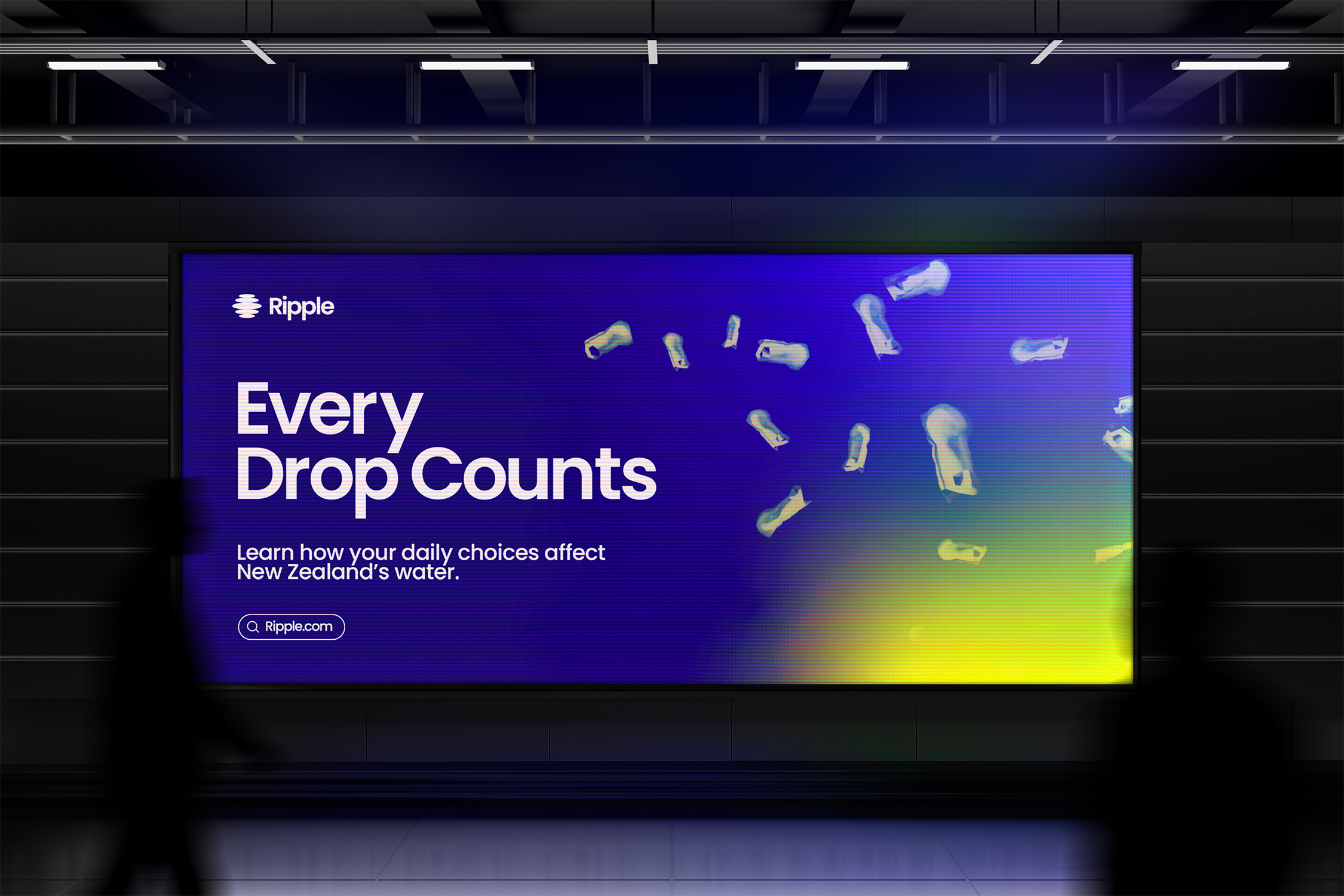
Interactive Installation · Motion Tracking · Generative Design · Live Brief
RIPPLE
Ripple is an interactive installation that transforms human movement into real-time visual feedback. Built with TouchDesigner and motion-tracked via Xbox Kinect, the experience responds to hand gestures symbolising humans water pollution over time, Developed as a live brief with Adobe, Ripple explores the boundary between digital interaction and embodied presence.
Problem Statement
How can we inspire and empower young urban Aucklanders, aged 18–25 to actively participate in safeguarding New Zealand’s freshwater resources, Through an interactive, digitally-driven exhibition aligned with Adobe’s “Create The Future” brand pillar?
Developed under Adobe's Create The Future brand pillar, Ripple was tasked with inspiring meaningful action through design and technology.
To ignite awareness and responsibility among Auckland’s youth by using technology, to show the tangible impact of individual choices on New Zealand’s precious freshwater resources.
A projection-based interactive installation that places the user at the centre of the issue. By tracking movement through an Xbox Kinect, Ripple responds to the body in real time turning passive observation into active participation, and awareness into accountability.
Kinect & Motion Tracking Exploration
Working with the Kinect to adapt the graphical element with motion tracking
The original concept was a reactive floor installation responding to footsteps in real time, but floor-plane tracking requires a level of depth sensor precision that quickly felt like the wrong hill to climb. Shifting to a wall projection made everything click. The Kinect handles forward-facing depth tracking well, hand motion became a natural fit, and it removed the need for any risky overhead mounting.
The two concepts below show the progression of hand tracking with TouchDesigner and adding the graphical element of the flowing water.
Applying The Concept
Merging the motion tracking and graphical element together.
Up until this point, the hand tracking and the visual element had been living separately. The Kinect was doing its job, and the flowing water graphic existed on its own. The next step was then to attach one to the other. In practice, seeing it work for the first time was very rewarding.
Taking it off the screen and throwing it onto a wall using a projector changed everything about how it felt.
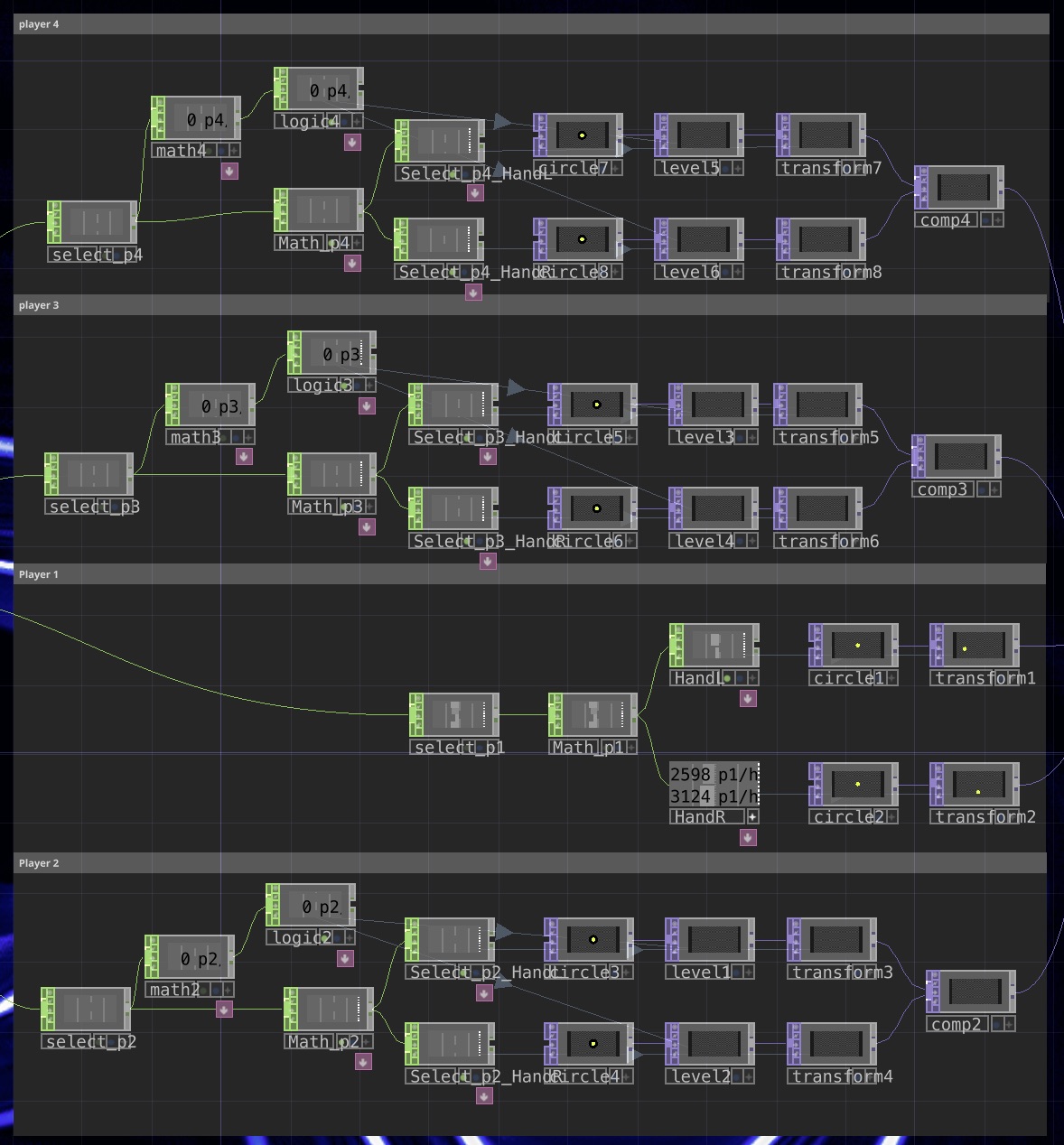
4 Player Interaction System
Scaling the experience from one person to four
The exhibit was always designed for multiple people. To support that, the system was built to handle up to four simultaneous players each tracked independently by the Kinect within the same frame.
Each player is assigned a circle the moment they enter the Kinect's field of view. When they step out, their circle is removed immediately keeping the projection clean and ensuring no ghost elements interfere with active players.
Graphical Development
Enhancing the graphical elemement of the clean and polluted water
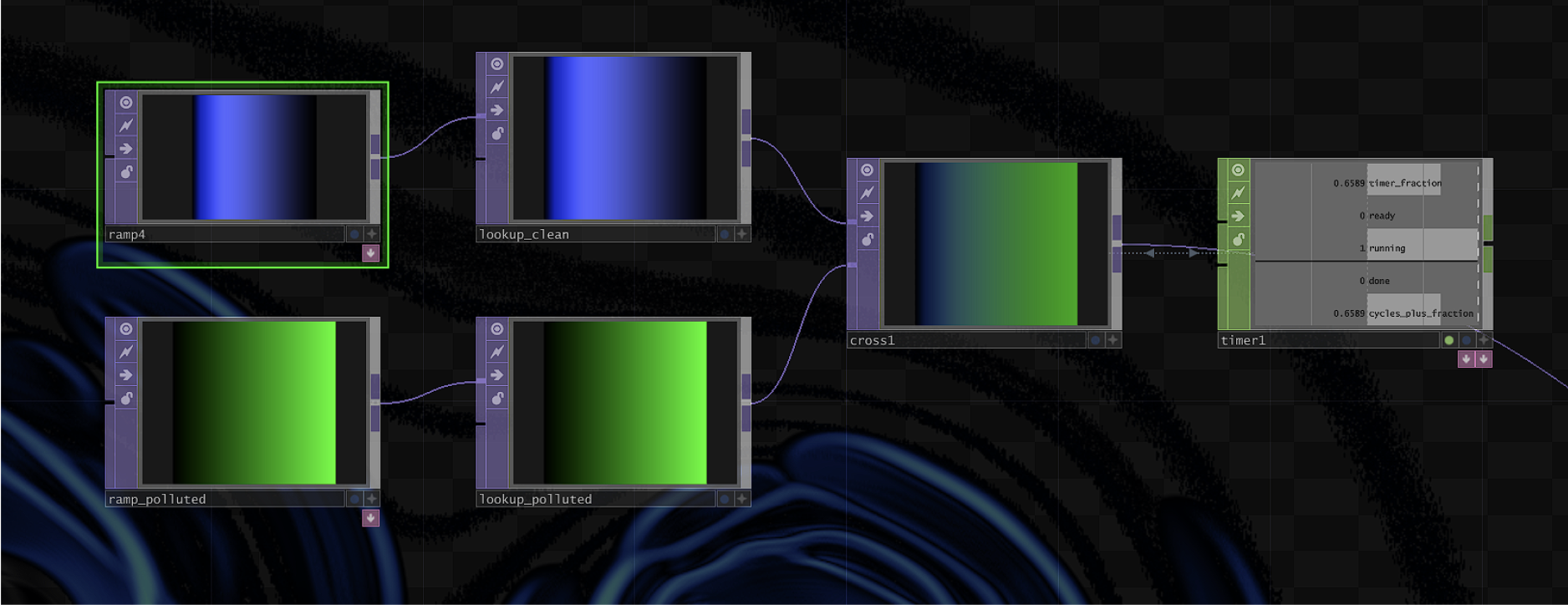
Ehnancing the two states defined of colour deep blue for clean water, vibrant green for pollution.
Colour Cycle
Simulating the passage of time with pollution
A continuous automated cycle shifts the entire canvas from blue to green over time when the user interacts, clean water slowly becoming polluted regardless of user input. This passive drift was intentional pollution doesn't wait for interaction, it happens whether you engage with it
Final States
Final state of clean and polluted experience
The blue state at its final form deep, dark tones with responsive ripple trails.
The green state fully pushed vibrant and unsettling, the smokey pollution effect saturating the surface. The same topography lines now feel corrupted rather than natural.
Final Outcome
Clean and polluted water colliding for the full experience
Blue and green meet the two states bleeding into one another as the colour cycle drives the world from clean to polluted over time. Ripple trails, and the smokey pollution effect all working together as a single cohesive vibrant experience.